
(This is an excerpt from the book The Coming Disruption by Fred Voccola, CEO of Simpro Group and former CEO of Kaseya).
Imagine you’re living 65 million years ago, and you look up to see a bright streak cutting across the sky. At first, it’s small, barely noticeable. A few creatures glance up, shrug, and go back to whatever they’re doing. But the streak gets bigger. Brighter. Hotter. And then it hits. In an instant, the world changes forever. Species that thrived for millions of years are gone—wiped out—not because they were weak, but because they couldn’t adapt fast enough to the new reality.
That’s AI.
It’s not a slow-moving weather pattern you can watch from the porch and decide what to do about later. It’s a meteor—already in the atmosphere—moving at a speed you can’t outrun. And the organizations, leaders, and workers who don’t immediately adapt will go the way of the dinosaurs. AI isn’t just a new tool—it’s an extinction-level event for the slow and complacent, and a generational leap forward for the fast and decisive.
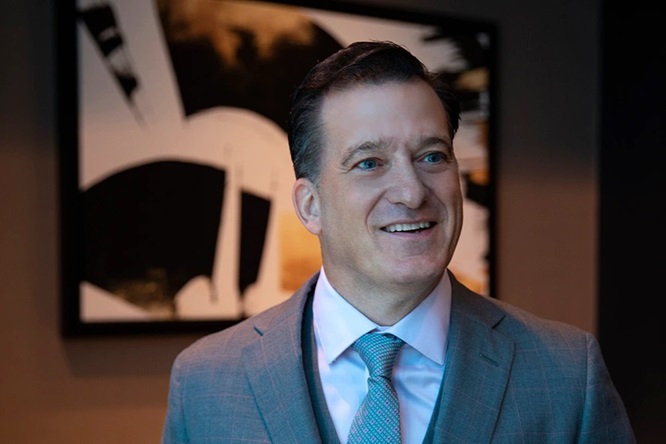 Fred Voccola
AI isn’t tomorrow’s experiment—it’s today’s battlefield. Keep moving or get run over. It’s as simple—and brutal—as that.
Everyone’s talking about AI because for the first time in history, a tool exists that can replace not just manual labor or calculation—but thinking. Real, high-order, creative thinking. And not just once—but billions of times a second, across the globe.
If AI is the meteor already tearing through our atmosphere, then the place where the shockwave will be felt first and most violently is the world of business and organizations. Not just tech companies or Silicon Valley darlings, but every enterprise, small company, agency, nonprofit, university, and institution that forms the backbone of our prosperity and civilization. These are the entities that coordinate human effort, allocate resources, create jobs, produce food, develop medicines, enforce laws, and deliver the products and services that keep society functioning.
While AI will transform every corner of human life—how we learn, govern, heal, and connect—I want to focus on the single arena where it will decide the pace and shape of our future: the businesses and organizations that run our world.
When these institutions embrace AI, they amplify productivity, unlock innovation, and create new possibilities for billions of people. When they resist, they choke progress, lose competitiveness, and destabilize the systems on which we all rely.
That’s why you should care—because whether you’re a CEO, a policymaker, a teacher, or simply someone who depends on the stability of the society around you, what happens inside these organizations will determine whether AI’s meteor strike leads to a golden age or an extinction event.
If your organization is not committed to being AI First now (not “three years from now”), you are more than at risk—you are already behind. You are already bleeding market share, losing your business moat, and wasting time. Extinction isn't a metaphor. It’s on your calendar.
And this isn't just about large companies. It’s about all companies: small-to-medium-sized businesses to Fortune 100 behemoths. It’s governments. Universities. Non-profits. The consequences will be universal and permanent.
The Most Potent Development in Human History
Let’s not hedge. AI is the single most important development in the history of our species.
More than the wheel, the steam engine, electricity, penicillin, the Internet, or anything else. All those innovations changed the world. But here is the main difference. AI changes how the world changes.
It’s not that those other innovations weren’t massive—they were. But AI allows us to harness the full power of all of them—and apply them faster and cheaper than ever before.
This is an exponential leap in what is possible. It is the first time in history when humanity doesn’t just have a new tool—it has a million tools, instantly available to anyone who knows how to ask the right questions.
It doesn’t rest. It doesn’t complain. And it never stops improving.
The projections about what AI is doing and will do to our society and businesses are unbelievable.
Some Crazy Sci-Fi Stuff
Futurists and leading technologists predict that AI will unlock possibilities so crazy they sound ripped from science fiction. Think about AI-driven brain–computer interfaces that allow people to communicate telepathically—no talking, no typing, just thought-to-thought connection. Elon Musk’s Neuralink is already experimenting with this, but AI could scale it to billions of people, enabling global communication networks straight out of a sci-fi novel.
On the medical frontier, researchers predict AI-powered nanobots in the bloodstream that detect disease instantly, repair tissue, or even slow down aging. There are scientists who believe AI might eventually extend human lifespans by decades—or even indefinitely—by cracking the code of biological aging.
Defense analysts even speculate about fully autonomous armies of drones and robotics, where wars are fought algorithm vs. algorithm— raising existential questions about power, deterrence, and control.
Others envision AI-managed cities, where traffic, power, housing, and healthcare are all continuously optimized by learning systems. Imagine a city with no traffic jams, no blackouts, and zero waste because every system is harmonized in real-time.
Imagine AI coordinating fleets of autonomous machines to terraform planets—managing climate systems, balancing atmospheres, and even seeding life to make Mars or other worlds habitable.
Self-replicating robots guided by AI could mine asteroids and build massive space habitats, effectively extending civilization beyond Earth. Some visionaries argue AI might one day help re-engineer the human body itself to survive in alien environments—designing biology that can thrive under new skies.
And here’s one of the most jaw-dropping concepts: AI helping us simulate and map consciousness itself—potentially digitizing aspects of human thought or even creating AI-human hybrids. Some predict that by mid-21st-century, we may face questions about whether “uploaded minds” count as people.
As wild as these sound, they’re not idle fantasies. They’re topics being debated in research labs, government task forces, and boardrooms of trillion-dollar companies right now. The line between science fiction and business planning is disappearing faster than anyone expected.
And that’s the point.
This isn’t about some distant future. It’s about what happens next—inside your organization, your industry, and your career—whether you’re ready or not.
Welcome to the AI Age.
Excerpted from The Coming Disruption by Fred Voccola (Atlas Elite Publishing Partners, November 18, 2025). 2025 Fred Voccola. All rights reserved.